Sugar, Hormones and the Afternoon Cliff
Why a piece of cake doesn't behave the way it used to, and what your body's actually doing about it.
Let me describe an afternoon for you. See if it rings any bells.
You've had a perfectly reasonable lunch. Not even hungry, really. You ate the thing. You went back to your day.
A couple of hours later, your brain has fogged over, you'd happily put your head down on the desk, and something deep in your subconscious is whispering quite firmly about biscuits.
If you've been wondering why this is suddenly a daily event, when it used to be a once-in-a-while sort of thing, the answer is sitting in your bloodstream right now.
And the answer is rather interesting once you know it.
What's actually going on
When you eat anything that contains carbohydrates (bread, pasta, biscuits, fruit, the not-so-innocent granola), your blood sugar rises. This is normal. This is meant to happen.
Your pancreas then sends out a hormone called insulin. Insulin's job is to gently shepherd the sugar out of your blood and into your cells, where it gets used for energy.
So far, so functional.
The trouble starts when the food you've eaten causes a big, fast rise. The body, slightly alarmed by the spike, sends out a lot of insulin. Insulin does its job, and then some. Your blood sugar plummets, often below where it started.
That's the afternoon cliff. The moment you feel like you've been unplugged.
And that's when you start eyeing the biscuit tin. Not because you're greedy. Because your body is, frankly, panicking. It wants its energy back, and it wants it fast.
The bit nobody told us about
Here's what really matters in midlife.
For decades, oestrogen has been doing you a quiet favour. It helps your cells respond well to insulin. It keeps the spikes smaller.
It keeps the crashes gentler. It makes the whole system run a bit more smoothly.
As you move into perimenopause and beyond, oestrogen levels start to drop. And so does that lovely buffer.
The result? The same food that was perfectly fine in your thirties now sends your blood sugar shooting up, and crashing down, in a way it never used to. The cake you ate happily at thirty-five behaves entirely differently at forty-eight.
You haven't changed. Your body's rules have.
Why it shows up in so many places
Once you understand the spike-and-crash, a lot of midlife mysteries start to make sense.
The afternoon fog.That's the crash. You're not tired. You're under-fuelled because you over-spiked.
The midsection that suddenly arrived uninvited.When insulin is high and frequently spiking, it sends a strong signal to store fat, and it has a particular fondness for storing that fat around the abdomen. The same calories now park themselves in different places.
The cravings that feel almost involuntary.They are, in a way. When blood sugar crashes, the brain demands fast fuel. That isn't a willpower problem. That's biology being efficient.
The disrupted sleep.Blood sugar volatility through the day affects how you sleep at night. Poor sleep then makes the next day's blood sugar even harder to manage. It's a loop, and not a fun one.
The hot flushes that seem to come out of nowhere.Plenty of women find their flushes are noticeably worse after a sugary meal or a glass of wine on an empty stomach. The spike triggers a stress response, and the body responds with, among other things, heat.
The mood swings.Blood sugar crashes affect mood. Of course they do. Anyone who's tried to be reasonable when they're starving knows this. Now imagine that happening four or five times a day without realising.
The very good news
You don't need to go on a diet. You don't need to live without sugar. You don't need another set of rules you'll quietly break by Wednesday.
You just need to soften the spikes.
That's the whole game. Not avoidance. Just steadier.
A few small things that work surprisingly well:
Eat your protein and fat before your carbs.Same meal, same plate, just start with the eggs, the salmon, the chicken, the cheese, before you go in on the bread or the rice. The protein and fat slow everything down. The spike becomes a gentle rise.
Move for ten minutes after eating.A short walk after a meal, even round the kitchen, softens the spike dramatically. Your muscles use up some of the sugar before insulin has to do all the work.
Watch the "healthy" things that aren't.Granola, fruit smoothies, dried fruit, those overnight oat pots that look virtuous, flapjacks calling themselves "energy bites". They behave in your body very much like cake. They aren't bad. They just aren't the calm, blood-sugar-friendly choice they're often dressed up as.
A tablespoon of vinegar in water before a higher-carb meal.I know. It sounds mad. It works, and the research is solid. Cuts the spike noticeably.
Get the sleep you can.Poor sleep makes your blood sugar harder to manage the next day. Good sleep makes the whole thing easier. It's one of the biggest levers you've got.
A small confession
For years I thought I was just bad at afternoons. I'd be flying through the morning, productive and chipper. Then somewhere after lunch I'd hit a wall. Not tiredness exactly. More like someone had thrown a blanket over my brain.
I tried everything. More coffee. Less coffee. Walks. Going outside. Drinking more water.
What cracked it wasn't more discipline. It was a long weekend in Spain.
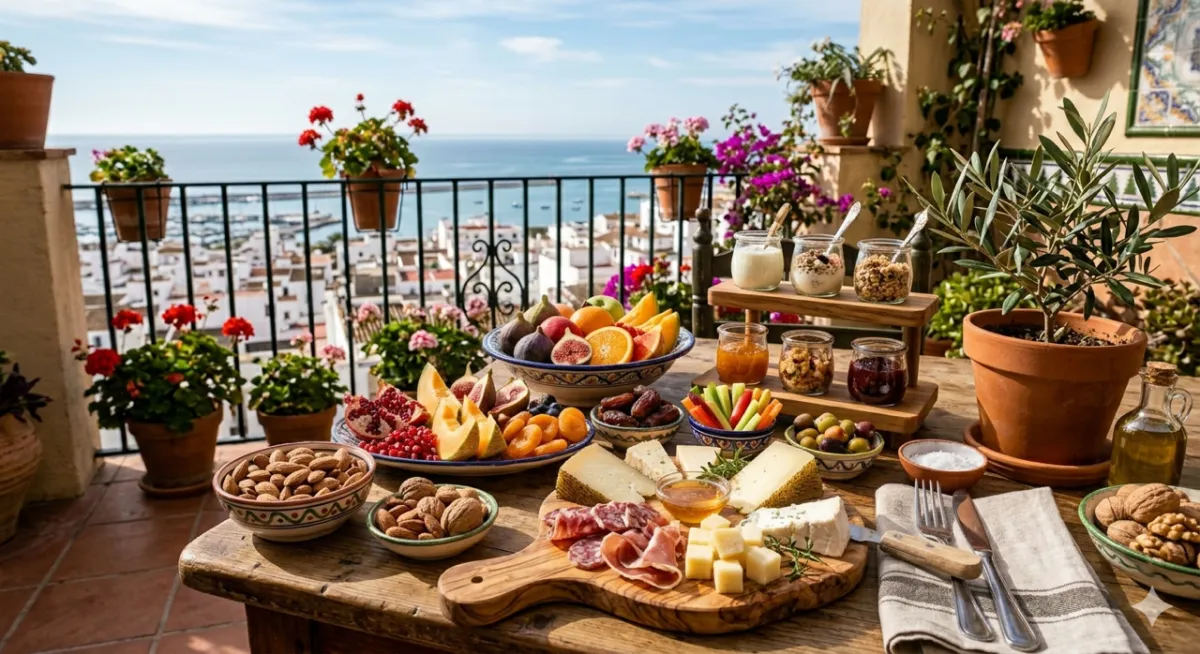
Continental breakfasts every morning: eggs, a bit of ham, some cheese, a slice of tomato. No bread, mainly because I couldn't be bothered to ask for it. By day three I noticed something genuinely weird. The afternoon slump had vanished. Not improved. Vanished. I had energy in the evening that I hadn't had in about four years.
I came home, went back to my granola, and the slump came back within a day.
That was the moment I stopped blaming myself for something my hormones had quietly started doing on my behalf. It was also the moment I started paying attention to what I was eating. Not because I was on a diet. Because I'd seen what was possible.
Where to start
Pick one thing. Genuinely one. Not all five. Just one.
Try a savoury breakfast for a week and see. Or eat your protein before your carbs at dinner. Or take a short walk after lunch. Or move the fruit smoothie to after a meal rather than instead of one.
See what happens. Notice your afternoons. Notice your evenings. Notice whether the biscuit tin's stopped calling your name.
Then come back and tell me how you got on. I read every reply.
You haven't been lazy. You haven't been weak. You've been working with a body that quietly changed the rules without sending you a memo.
Now you've got the memo.
Love,
Trudi x
